
Fraud in regulated industries has entered a new phase. Synthetic identities, deepfake documents, and AI-generated personas are putting pressure on retirement plans, insurance providers, and health study administrators who depend on accurate participant data. At the same time, the tools available to combat these threats have grown significantly. AI identity verification and AI fraud prevention are changing the way fiduciaries validate records, flag anomalies, and maintain compliance with federal and state regulations.
For organizations managing pension disbursements, policyholder records, or longitudinal research populations, the stakes are high. A single undetected death can lead to months of overpayments. A fraudulent identity can compromise an entire study cohort. Understanding how AI is being applied across the compliance landscape is no longer optional for organizations operating under fiduciary obligations.
The Growing Complexity of Identity Fraud in Regulated Industries
Identity fraud has evolved well beyond stolen Social Security numbers and forged documents. According to a 2025 report from Sumsub, identity crime has undergone what researchers call a “sophistication shift,” where fewer bad actors are involved, but their operations are far more coordinated and technologically advanced. Global losses from identity fraud exceeded $50 billion in 2025, and early indicators suggest that figure will continue to climb.
Traditional verification methods, such as periodic checks against the Social Security Administration’s Death Master File (DMF), were once sufficient. But the DMF’s coverage has declined sharply since 2011, when policy changes restricted access to death records. Today, the DMF identifies only a fraction of deaths. That gap has forced fiduciaries to seek additional data sources and verification methods to maintain the integrity of their records.

How AI Fraud Detection Is Changing the Game
In the context of death audits, for example, AI-powered systems can cross-reference participant records against obituary databases, state vital records, public records, and proprietary data sources simultaneously. Rather than waiting for a monthly or quarterly batch update, AI compliance tools can flag potential matches on a daily basis, giving administrators the ability to act before overpayments accumulate.
AI also plays a role in detecting synthetic identities. These are fabricated profiles that blend real and fictitious information to pass standard verification checks. For pension plans, a synthetic identity might be used to continue collecting benefits long after a participant has died. For insurers, it might be used to open fraudulent policies. AI models trained on behavioral and contextual signals can identify the subtle inconsistencies that characterize these fabrications, catching what rule-based systems tend to miss.
AI & Fraud Prevention in Retirement and Pension Administration
Retirement systems and pension funds are among the most vulnerable targets for fraud related to unreported deaths and identity manipulation. The consequences are not abstract. A 2024 audit of a California county retirement system’s records uncovered several deaths that the fund’s existing vendor had missed entirely, resulting in over $300,000 in overpayments from just 8,000 records reviewed.

AI and fraud prevention go hand in hand in this space. Modern platforms use machine learning algorithms to match participant records against thousands of data sources, including national obituary databases that now contain millions of records. These platforms analyze multiple signals to produce matches with a high degree of confidence, including:
- Name variations and aliases across records and jurisdictions
- Dates of birth cross-referenced against obituary and vital records data
- Geographic signals such as last known address and state of residence
- Cross-source validation that corroborates findings across independent databases
Ultimately, this helps plan administrators identify deceased participants faster and with greater accuracy than was possible even a few years ago
Identity Verification & Fraud Prevention for Insurance Providers
Insurance companies face a dual challenge in identity verification and fraud prevention. On one side, they must verify that policyholders are who they claim to be at the point of onboarding. On the other hand, they must continuously monitor their existing books of business to identify deaths, detect fraudulent claims, and comply with state-level escheatment requirements for unclaimed property.
AI identity verification tools are increasingly capable of handling both sides of this equation. At onboarding, AI can analyze submitted documents, cross-reference applicant information against public and proprietary databases, and flag inconsistencies that may indicate a synthetic or stolen identity. Post-onboarding, AI-driven monitoring can detect changes in a policyholder’s status by pulling from obituary data, vital records, and other sources on a rolling basis.
State legislatures have been active in this area as well. Currently, numerous states require insurance companies to periodically compare their policyholder data against the DMF. Given the well-documented decline in DMF coverage, insurers who rely solely on this source risk falling short of their compliance obligations. Supplementing the DMF with AI-powered platforms that aggregate data from tens of thousands of sources provides a much fuller picture.

AI in Fraud Detection and Prevention for Health Studies
Health studies present a unique set of requirements for AI in fraud detection and prevention. Researchers conducting clinical trials, epidemiological studies, and longitudinal population analyses need to know the mortality status of their participants to maintain the validity of their findings. If a death goes unrecorded, it can introduce bias into survival analyses and distort outcome data.
The challenge is compounded by the mobility of study populations. Participants move, change names, and may pass away in jurisdictions far from where they were originally enrolled. AI-powered matching tools address this by analyzing multiple identity attributes simultaneously, including name, date of birth, last known address, and Social Security number, to locate participants across geographic boundaries.
Risk management with AI also extends to data security in the health studies context. Research data is subject to HIPAA and, in many cases, FDA regulations. AI compliance tools designed for this space must operate within those regulatory frameworks, processing sensitive participant information without exposing it to unnecessary risk. Platforms that can conduct mortality verification using de-identified data or limited identifiers offer a significant advantage for researchers balancing accuracy with privacy.
The Role of AI Alongside Traditional Compliance Tools
AI does not operate in isolation. The most effective compliance programs integrate AI fraud detection with established verification methods such as TIN/EIN screening, sanctions list checks, and SSN verification. These traditional tools remain important for confirming specific data points, while AI adds a layer of pattern recognition and anomaly detection that static checks cannot provide.
For example, a pension administrator might use SSN verification to confirm a participant’s identity at enrollment, then rely on AI-driven daily monitoring to track that participant’s status over the life of the plan. If the AI system identifies a potential death match through obituary data, the administrator can then use traditional tools, such as death certificate requests or state vital records, to confirm the finding before taking action.
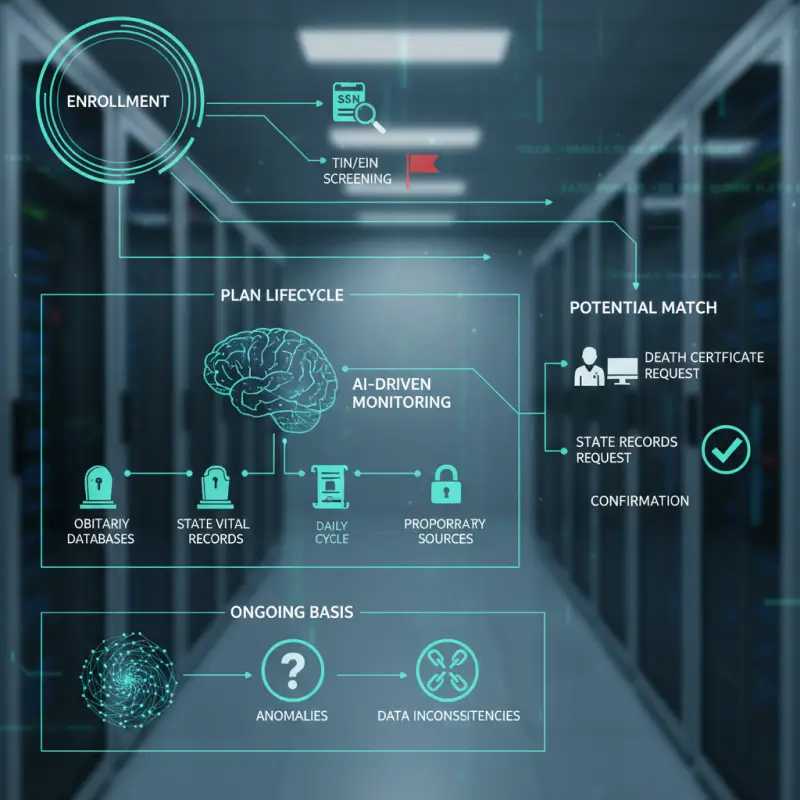
This layered approach reflects a broader trend across regulated industries. Compliance is moving toward continuous verification rather than one-time checks, and the most effective programs combine AI with established methods in a structured workflow:
- At enrollment, SSN verification and TIN/EIN screening confirm a participant’s identity and flag any sanctions list matches.
- During the plan lifecycle, AI-driven monitoring continuously tracks participant status against obituary databases, state vital records, and proprietary sources on a daily cycle.
- When a potential match surfaces, administrators use traditional tools such as death certificate requests or state records to confirm the finding before taking action.
- On an ongoing basis, AI pattern recognition identifies anomalies and data inconsistencies that static, point-in-time checks would miss entirely.
AI provides the infrastructure for this shift, enabling organizations to maintain an up-to-date view of their participant populations without overwhelming their administrative resources.
Why Choosing the Right AI-Powered Partner Matters
Not all AI compliance tools are built the same. The accuracy of an AI-driven verification system depends heavily on the breadth and quality of its underlying data sources, the sophistication of its matching algorithms, and the security of its infrastructure. Organizations evaluating partners in this space should consider several factors: how frequently data is updated, how many sources are aggregated, whether results are validated before reporting, and what security certifications the provider holds.
LifeStatus360 has built its platform around these priorities. Our proprietary SaaS platform integrates the Social Security Administration Death Master File, state vital records, and our Obit360 obituary database, which draws from millions of obituary and death notice records, to provide daily updates to our customers. Our matching algorithms analyze name variations, dates of birth, geographic data, and cross-source signals to produce accurate, actionable results. Housed in a Class A security building with 24-hour security and advanced data protection protocols, our infrastructure is designed to meet the demands of fiduciaries across retirement, insurance, and health study industries.
Frequently Asked Questions About AI Identity Verification & Fraud Prevention
Can AI‑powered identity verification tools be legally used in place of certified Death Master File access for compliance purposes?
AI-powered identity verification tools are not a legal substitute for the certified Death Master File in situations where federal or state regulations specifically require DMF access. However, the DMF’s coverage has declined significantly since 2011 and now identifies only a small percentage of deaths. AI-powered tools that aggregate data from obituary databases, state vital records, and proprietary sources can supplement DMF access to provide a far more complete picture of participant mortality. Many fiduciaries use AI platforms alongside their certified DMF access to close the gaps that the DMF alone cannot address. Organizations should consult with legal counsel to confirm that their compliance approach satisfies all applicable regulatory requirements.
How do AI and traditional risk tools (like TIN/EIN and sanctions screening) work together in identity verification?
AI and traditional verification tools serve complementary functions. TIN/EIN verification and sanctions screening confirm specific data points at a given moment, such as whether a taxpayer identification number is valid or whether an individual appears on a government watchlist. AI adds an ongoing layer of analysis by monitoring participant records against thousands of data sources, identifying anomalies, and flagging potential matches with deceased individuals or suspicious identities over time. When used together, these tools create a layered compliance framework in which static verification establishes a baseline and AI-driven monitoring maintains data accuracy continuously.
How quickly can AI‑enhanced mortality verification tools identify deaths compared to traditional methods?
Traditional death audit providers often update records on a monthly, quarterly, or even annual basis. AI-enhanced mortality verification platforms can process incoming death data from obituaries, state vital records, and other sources daily, flagging potential matches as soon as the data becomes available. This represents a significant reduction in the lag time between a death event and its identification in plan records. Faster identification means fewer overpayments, lower financial exposure, and a stronger compliance posture for retirement plans, insurance providers, and health study administrators.
Take the Next Step Toward Smarter Compliance
If unreported deaths, outdated records, or gaps in your verification process are putting your organization at risk, LifeStatus360 can help. Our proprietary SaaS platform provides daily mortality monitoring, AI-powered matching across millions of obituary and public records, and secure access to the data your compliance team needs to stay ahead.
Whether you manage a pension fund, an insurance book of business, or a health study population, we invite you to experience the difference firsthand. Contact us today or call 888-LIFE-360 to schedule a walkthrough of our platform.